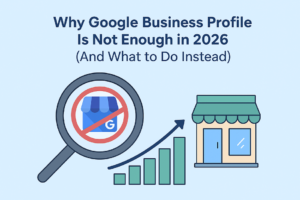
Google Business Profile alone is no longer sufficient for local SEO success in 2026.
Why Google Business Profile Is Not Enough in 2026 (And What to Do Instead)
Google Business Profile has long been positioned as the foundation of local visibility, but relying on it alone is no longer a viable growth strategy in 2026.
Google’s official Business Profile guidelines
,
profiles are subject to policy changes and visibility limitations that directly impact long-term performance.
In this article, we explain why Google Business Profile 2026 expectations fall short and what to do instead to achieve sustainable growth.
Google Business Profile 2026: Why the Old Model No Longer Works
Google Business Profile 2026 represents a more restrictive and competitive environment than ever before. While GBP still plays an important role, Google has reduced organic exposure, added more paid placements, and limited how much control businesses truly have over their profiles.
Local results are increasingly crowded with ads, Google Local Service Ads, and AI-powered recommendations. Even fully optimized profiles struggle to maintain consistent rankings, especially in competitive service areas. This makes local search visibility unstable when GBP is your only channel.
In addition, GBP is not an owned platform. Google can suspend profiles, change rules, or alter ranking factors without warning, instantly impacting leads and revenue.
The Hidden Risks of Relying Only on Google Maps SEO
Google Maps SEO has become more unpredictable due to frequent algorithm updates and proximity-based ranking bias. Businesses that depend entirely on map pack rankings often experience sharp traffic drops overnight.
Common risks include:
- Profile suspensions without clear explanations
- Inconsistent rankings across locations
- Limited access to customer data
- High dependency on reviews for visibility
Because Google Maps SEO prioritizes proximity and engagement signals, many high-quality businesses lose visibility simply due to location constraints. This creates an uneven playing field and limits scalability.
Local SEO Strategy Must Extend Beyond Google Business Profile
A modern local SEO strategy requires diversification beyond a single Google-owned asset. As outlined in the
Google Search Central SEO Starter Guide
,
businesses that win in 2026 focus on building strong websites and content ecosystems they fully control.
This approach reduces risk and increases long-term performance. A comprehensive local SEO strategy includes technical optimization, content development, authority building, and conversion optimization across owned platforms.
Why Owned Digital Assets Matter More Than Ever
Owned digital assets are platforms and data sources fully controlled by your business, such as your website, CRM, email list, and content library. Unlike Google Business Profile, these assets cannot be taken away or restricted by algorithm changes.
When you invest in owned digital assets, you gain:
- Full control over messaging and branding
- Direct access to customer data
- Stable long-term traffic sources
- Higher conversion potential
This shift is critical for building a resilient local presence that survives Google updates.
Business Website Optimization as the Core of Local SEO
Business website optimization is the most effective way to regain control over your local search performance. Your website should act as the central hub for all local signals, content, and conversions.
A properly optimized local website includes:
- Dedicated location-based service pages
- Clear NAP (Name, Address, Phone) consistency
- Fast loading speeds and mobile usability
- Structured data and schema markup
Unlike GBP, your website can rank organically across multiple keywords, service areas, and search intents—significantly expanding your reach.
Location Pages and Content Depth
Local SEO performance improves dramatically when businesses create high-quality location pages that answer specific user needs. These pages should include localized content, FAQs, testimonials, and service details.
Search engines reward depth, relevance, and clarity. This is something Google Business Profile simply cannot provide at scale.
First-Party Data: The Competitive Advantage in 2026
First-party data is data you collect directly from your audience through forms, calls, bookings, and email subscriptions. In 2026, this data is one of the most valuable assets for local businesses.
Insights from
Think with Google
show that companies leveraging first-party data outperform competitors in personalization and conversion optimization.
With first-party data, you can:
- Understand customer behavior and intent
- Improve conversion rates
- Run more effective remarketing campaigns
- Reduce dependence on third-party platforms
Google Business Profile offers limited insights and no true data ownership, making it insufficient for long-term growth.
Building Sustainable Local Search Visibility
Local search visibility in 2026 depends on consistency, authority, and user experience across multiple touchpoints. Businesses that rank consistently invest in trust-building signals beyond Google Maps.
Key components include:
- High-quality local content
- Authoritative backlinks
- Review diversification across platforms
- Technical SEO best practices
This holistic approach ensures visibility even when map rankings fluctuate.
Sustainable Local SEO: What to Do Instead of Relying on GBP
Sustainable local SEO focuses on long-term stability rather than short-term map pack wins. Instead of chasing GBP hacks, businesses should build systems that compound value over time.
A sustainable approach includes:
- Using Google Business Profile as a trust signal, not a traffic source
- Prioritizing business website optimization
- Investing in owned digital assets
- Leveraging first-party data for growth
This strategy aligns with how search engines evaluate authority, relevance, and trust in 2026.
Conclusion: Google Business Profile Is a Tool, Not a Strategy
Google Business Profile remains valuable, but it is no longer sufficient as a standalone solution. Businesses that rely solely on GBP expose themselves to unnecessary risk and limited growth.
By shifting focus to local SEO, strengthening owned digital assets, and committing to sustainable local SEO, brands can achieve consistent visibility, higher conversions, and long-term resilience in an increasingly competitive local search landscape.